


NHS campaigner and opponent of NHS Americanisation Nico Csergö writes about another Establishment event to smooth over more US-copied NHS dismantling

Remember these? Your closed A&E, you ex consultant-led maternity unit, your former local district general hospital. The GP you used to be able to see as a right. They were part of the full health service afforded everyone as a right after World War II. What we called the NHS.
But from the point of view of private healthcare, all these things are unprofitable obstacles to growing their business – so detailed government policy programmes have for decades targeted them for closure and downgrade and continue to do so with impunity. In sunshine and rain, in high funding and low. They can get away with doing this because all the main parties, whether in government or opposition, drink from the same trough or can’t be bothered to challenge the narratives covering it up.
And also because many on the left haven’t figured those narratives out.
Local bodies get a financial carrot and stick to incentivise them to attack those services, despite local opposition to the cuts and closures. And it’s that carrot-and-stick system, of incentives to act in benefit of private healthcare expansion, that the UK first began copying from the USA – 35 years ago this month.
On Wednesday, the London School of Economics (LSE) hosted a programme that involves speakers who despite being largely unknown to the wider public, in my opinion bear special responsibility for taking the UK down the road to an ever-thinner gruel of US-government-style healthcare: Tony Blair’s special advisor on healthcare privatisation (it’s always this crew, in my experience) Julian Le Grand and someone who’s been through more thinktank and government roles than you could shake a stick at – Jennifer Dixon.
Dixon has written about (and in support of) parallel policy developments between US and UK health policy in a way that, in my analysis, makes her a think-tanker and government Americaniser. She is the co-author of “Health-care reforms in the USA and England: areas for useful learning” (2012), the abstract of which concludes: “The new accountable care organisations and clinical commissioning groups have much to learn from each other as they develop.” This was written a couple of years before it was announced that England would be adopting accountable care organisations themselves.
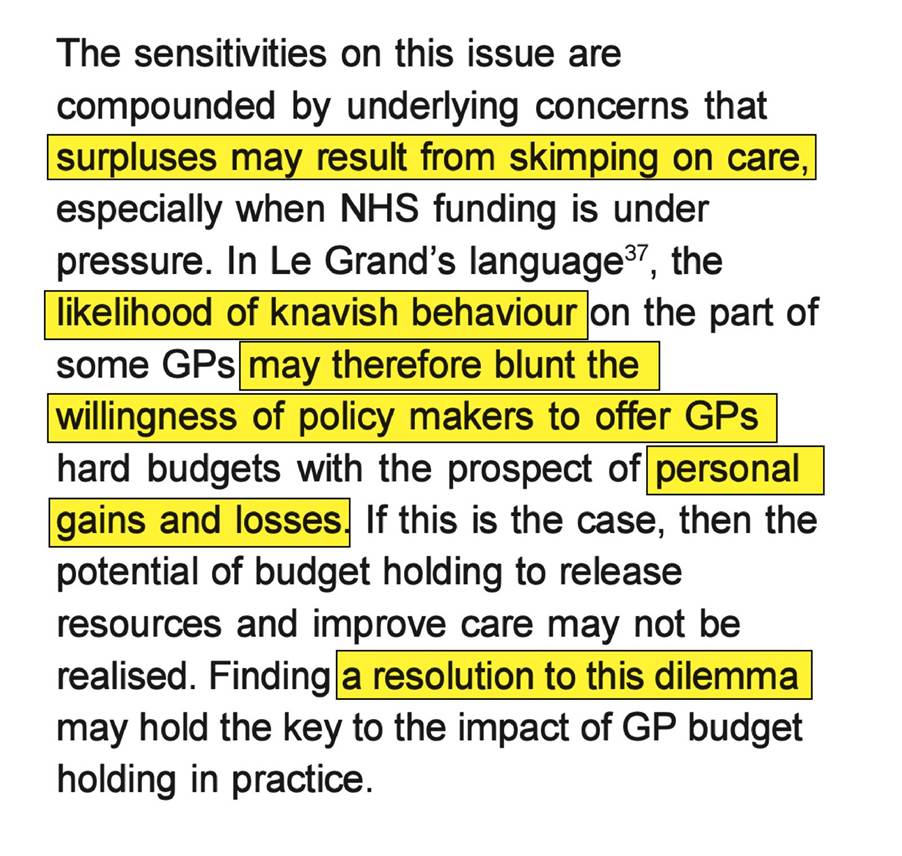
Also one of Blair’s top privatisers, Julian le Grand is “one of the principal architects of the UK’s public service reforms [in] health care and education“ according to the LSE itself. In “GP Budget Holding: Lessons from Across the Pond and from the NHS” (2010) Chris Ham, another Blairite I consider to be a ghoul of health-privatisation, cites Le Grand’s discussion on the importance of going full throttle on the American cuts for cash system that Thatcher/Major governments imported in early form as “GP fundholding” and which is now the national health rationing system called “Integrated Care”, to which the Starmer government is fully committed:
The event followed the usual poor excuse for “analysis” that blames today’s reduced government healthcare on anything but the cuts agenda that such ‘experts’ have pursued relentlessly for years.
However, over a decade of austerity funding, compounded by the impact of the COVID-19 pandemic, has exposed its vulnerabilities. The NHS has shown limited resilience to external shocks and appears increasingly unsustainable in the face of growing demand.
The promotional page for the LSE event “The NHS at 77: a national treasure or a system in crisis?”
It’s just uncanny how fate itself just happens always to be pushing us further and further into “more radical reforms” they innocently wonder. For a supposedly ‘honest’ conversation on an area of public life extensively dominated by corporate influence, the silence on corporations’ political and financial role in the collapse of the NHS is striking.
The truth is simpler and rather different. Labour and Tory guests at this event have played a leading role in the gradual removal of our essential but unprofitable local services, by replicating the USA’s cash rewards for deliberately withhold government care, by installing the profit motive for cutbacks into the very heart of health policy. They should and must no longer get a free pass for quietly removing what the British public cares most about.
Please remember to support Skwawkbox if you can, to help ensure it can keep running. The site is provided free of charge but depends on the support of its readers to be viable. If you’d like to help it keep revealing the news as it is and not what the Establishment wants you to hear – and can afford to without hardship – please click here to arrange a one-off or modest monthly donation via PayPal or here to set up a monthly donation via GoCardless (Skwawkbox will contact you to confirm the GoCardless amount as it has to be entered by us). Alternatively, if you prefer to make a one-off or recurring donation by simple card payment, please use the form below:
Make a one-time donation
Make a monthly donation
Make a yearly donation
Choose an amount
Or enter a custom amount
Your support is hugely appreciated.
Your support is hugely appreciated.
Your support is hugely appreciated.
Thanks for your solidarity so Skwawkbox can keep doing its job of inconveniencing the right and helping to build the left!
If you wish to republish this post for non-commercial use, you are welcome to do so, but please include the donor information above – see here for more.
Reeves has pocketed £27k from the new NHS landlord. Obviously to ease her pain. The labour club took another £17k.
But it’s small beer to what’s coming. Digital ID. And you’re not gonna be able to do sweet FA without it.
Has the hill finally arrived?
Kill schools hospitals and doctors surgeries with over-burdening administration! Easy ….
Recently, I drove my wife to a hospital appointment. For our area it is a substantial building. Only when I got inside the massive reception area did I see the large sign giving the various departments. I kid you not when I say there must have been upwards of 30 ADMINISTRATIVE departments. Their floor area was easily as large as the actual medical areas, and each specialist area had its own reception area which was staff to the gunwales. The area my wife needed had ONE surgeon (eastern European). If you need treatment the waiting list is 12 months.
But this enormous concentration on administration rather then the actual function spreads across the NHS, schools, police, Parliament and pretty much every public (and usually private) sector. If you take my experience in schools, admin CAN take up a Headteachers entire working time if they WANT it to. Much of it is totally pointless, and I used to file most of the stuff in the bin. Before I became a Headteacher, I was at a large school where there was a non-teaching Headteacher and two non-teaching deputies. It took all three of them several days to complete “Form 7” (the form listing the size of each class, plus a bit more detail). Great play was made about how complex this was. When I became a Head myself, I thought that for some peace and quiet with no interruptions, I had better go back in the evening when no-one was there to disturb me. After I had completed the entire thing in less than 30 minutes, panic set in …. I surely couldn’t fill in a form in 30 minutes that took three people several days? Actually I had. So I wonder how much admin time is wasted by those on the highest salaries. Then of course in schools we now have SATs, League tables, Ofsted, hours of governors meetings, all of them measuring the pig instead of feeding it. Just as a visit to the doctor has to start with a lengthy negotiation with a receptionist, instead of the old efficient version of turning up and awaiting your turn as used to happen in the UK and during our time there STILL occurs in many French doctors. I even had an operation in a French hospital where the surgeon himself came out to collect me from the reception area!
GREAT Article SW. The NHS is increasingly adopting American healthcare models, such as Accountable Care Organisations (ACOs) and Health Maintenance Organisations (HMOs), which prioritise cost reduction and efficiency over comprehensive care.
The NHS’s core principles of universal, comprehensive, and free at the point of delivery healthcare cannot endure under these ‘Americanised’ models.
THE LOSS OF PUBLIC CONTROL over healthcare and the inevitability of increased NHS privatisation are the sole intentions of these Americanised healthcare models.
Several American healthcare companies have already established a presence in the NHS to further their interests (including privatisation). For example, UnitedHealth Group, through its subsidiary Optum, provides various services, including referral facilitation and commissioning support. Other American companies, such as Centene, have also entered the market, raising concerns about the potential for profit-driven motives to overshadow the NHS’s commitment to universal, free healthcare.
A free, universal NHS is daily becoming less achievable and needs patients, physicians and healthcare providers to recognise the role of Labour, Lib Dem and Conservative politicians in facilitating the Americanisation and eventual death of universal, comprehensive, and free at the point of delivery healthcare – ie, the NHS most of us were born into and which we used to have – and then to re-establish it.
pah, lost track of me embolding. Sorry,but my words are clear…
Number of bankrupts due to healthcare costs per year:
USA 500,000.
UK 0.
Cost of major heart surgery:
USA $200,000.
UK 0.
USA HEAL THYSELF!
The Neo-Liberal Right hate the NHS because we are collectively caring for each other with our National insurance payments and somewhere at this moment in time someone is getting major health treatment & I’m happy to contribute to this as one day it might be my turn.
“THE NHS IS LOVE.”
I think the article swerved asking questions of the NHS and proceeded on the basis that it simply do everything asked of it, even as that ask gets ever larger. It rightly identifies the vultures circling ( and Palantir’s data grab is particularly concerning) but not that the victim is overburdened. The coexistent affection and frustration with the NHS needs to be the prompt for asking how much tax do we pay and what should it be spent on. You cannot both bribe an electorate with the promise of tax cuts and the expectation of even maintaining the current level of health provision. Once the US model takes hold it would be difficult to return to the current free provision but it is not free so much as continuing because of the funds we pay in taxes. Do we want free provision and if so how extensive should that provision be?
Some ideas from Richard J Murphy:
The NHS Funding Crisis