

Please read and share this widely – I think it might just be massive.
I wrote yesterday about the psychological bullying being inflicted on unemployed people by Jobcentre Plus on behalf of the Department of Work and Pensions, as huge, intimidating tasks are inflicted on people with minimal literacy, confidence and computer skills – backed by the threat of benefit ‘sanctions’ if they are not completed by a very short deadline.
But it gets even worse. One part of the series of tasks being imposed is an online ‘My strengths test’, consisting of a series of 48 multiple-choice answers to questions about your personality.
I can reveal that this ‘test’ is a completely bogus scam designed to manipulate unemployed people into performing a completely random, week-long exercise of incorporating supposed ‘characteristics’ into their daily behaviour.
How do I know this? Because the ‘test’ is fake – it allocates you a ‘personality’ even if you don’t answer the questions.
Try it for yourself here (at least until the government finds out it’s been rumbled and changes or removes the test). I clicked ‘next’ on each of the 48 questions until I reached the end. This is what came up after the last question page:

The page goes on to list 5 ‘strengths’ and to instruct respondents to enter their email address so they can discuss the ‘results’ with their Jobcentre Plus advisor. Not only this, but the covering letter that comes with the instruction to complete the ‘test’ tells the recipient that he or she must
use each of your strengths in a new way everyday (sic) for at least a week.
Untold numbers of people running around trying to use ‘strengths’ that actually have nothing to do with their actual personality – all under the threat of losing their income if they fail to comply.
A quick search of the root directory of the site reveals that, even though this site is called ‘Behaviour Library’, there are no other tests on the site. The title of the site is selected to give the impression that there is a scientific basis for the test and that it is conducted by some kind of specialist organisation competent to conduct psychometric testing – but there is not even any information to identify who devised the questions.
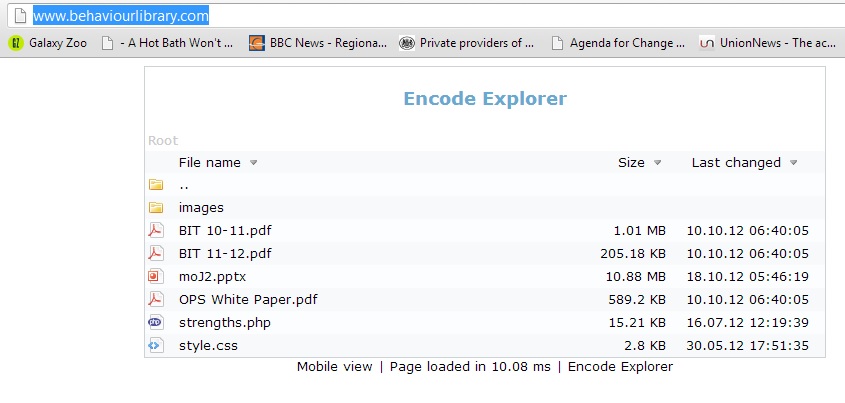
What there is, however, is a couple of Tory white papers – and a very revealing Powerpoint presentation. While the information in the presentation is clearly designed to provide prompts for someone to speak over, it is clearly about a particularly dark version of the government’s ‘nudge’ theory to influence behaviour.
This PowerPoint file contains some very sinister images about the kind of psychological impact the government is aiming for:


There is no doubt at all that the point of this ‘test’ – and the process of which it is part – is to terrify unemployed people into compliance and to set many up to fail so that they can be ‘sanctioned’ and have their benefits stopped.
Could there be any clearer demonstration that this government has no concern at all for the unemployed and the unfortunate? The Tories don’t even want everyone to be in work because they fear it would push up wages from the pathetic levels we see in many jobs – and it’s on the official record that this is the case.
But it goes beyond that. Chillingly, this Tory-led government has taken a cynical decision to terrify disadvantaged people into jumping through hoops to manipulate them into taking even the most insecure, unsuitable and low-paying jobs – or else be cast onto the ‘sanctioned’ heap and cut off from support anyway.
And this is not the only way they do it, as you’ll find out if you ask any disabled person about their experiences with the DWP – while they demonise them to turn so-called ‘strivers’ against them. Divide and conquer.
This ‘test’ is a tool for abuse and psychological torture and a ruse to fool the electorate into thinking the Tories are interested in getting people back to work. They’re interested in cutting them off from their benefits, but that’s a different matter altogether.
If you’re not worried about this, you should be. This is a government that wants the right to access all our emails and the right to try us in secret. If this is how they behave in one area, can they be trusted in any other?
This sinister government ploy needs to be exposed as the ‘Big Brother’ mind-control torture that it is – and its perpetrators must be held to account. Including David Cameron and Iain Duncan Smith.
DYNAMITE…reblogging now and linking back to here…for your run down and these comments
Thank you!
The available answers are all stored as plain text in the php scripts and very similar. I have a copy of the php files if you want them.
It gets worse ..Winston Smith 1984
As a disabled person I am regularly faced with the divide and conquer problem. Now if i leave my home I am assaulted. I have stones thrown at me, and it is getting worse
I’m so sorry to hear that. Would you be prepared to tell me more?
Sure, there are shouts of “get the cripple” i am regularly called a bebefit scrounger… I suffer from Ehler-danlos syndrome hypermobility type and am a full time wheelchair user. I also have severe epilepsy. I have been told that I dont belong in public as I am whats wrong with this country. A couple of months ago i was tipped out of my wheelchair and told to “go get a job” i have been stamped on during seizures and asked when i came round i should “stop putting it on for attention” its disgusting that in this day and age people feel the need to behave this way. Feel free to ask me anything
stevethesecretman, these are hate crimes and you should report them to the police. I am so sorry you are going through this. There are some evil people in this world 🙁
Apologies for being trite, but unfortunately there seems to be an inordinate number in this government.
As for your point I wholeheartedly agree, but unfortunately as we have seen on the news, there have been a number of cases which have ended in tragedy. I hope for stevethesecretman that he gets the help from the authorities that he deserves:-(
Seligman, who helped develop this, is controversial. He introduced “learned helplessness,” a basis of the American torture programme. He developed “positive psychology,” a scientifically dubious field. Now, the presentation combines intimidation and incentives, and the test involves “positive thinking.” Is this councidence? Also, Seligman is a controversial American psychologist, who was probably involved in the recent development of torture. See this: http://www.ethicalpsychology.org/materials/APA_&_US_Torture-Basic_Facts.pdf . To close, there’s a British connection: http://www.neweconomics.org/blog/2011/07/11/the-time-is-now-for-well-being-policy . I don’t know what if anything all this implies.
It just gets worse and worse. Do you have a source for his role in developing the test the DWP plagiarised?
I followed your links but to be honest you are being somewhat misinformed about learned helplessness/positive psychology. Seligman didn’t ‘introduce’ learned helplessness, but he did study the phenomenon and developed a well known theory of depression on the basis of those studies. This is old news in psychology – so much so that anyone with basic knowledge of psychology knows about learned helplessness. It’s only controversial in the sense that there are other competing theories, etc, just as there usually are in psychology as a discipline. He claims in the pdf that the talk he gave was on how soldiers can resist the effects of torture, which does make sense to me. Having said that, the psychology of torture is a big field and undoubtedly use has already been made of some of his research, but it’s unlikely that professional torturers would really need him to teach them the abc’s of something that has been around for so long at this stage. Positive psychology may be controversial in an academic sense, but it’s a bit twisted to try to make it sound like something evil. Possibly the tories are trying to put some of it’s principles to use, nothing is immune from being misused by evil people, unfortunately. I applaud you for looking into this, but it would be a good idea if having got this far you kept going and read some more on these subjects. I only am bothering to write this because it really did strike me as a very biased representation of 2 fields in psychology which are not controversial in the way which you imply.
Oh and PS I can’t be bothered to look for my copies of the tests that I have around somewhere to check, but it looks like this test may be based on the ‘Big 5’. I think there are usually more questions. The test itself would not be fake if that was the case, but probably not as reliable as one with more questions. I don’t know for sure though. My best guess at what has happened is that if you click all the way through your score (0) is the same for all 5 traits and so it gives you all 5 as strengths. This would be a programming failure. I didn’t try it twice to see what actually happens if you give real answers – IF it gives the same set of 5 strengths for any set of answers then yes, it’s either fake or they have a bug in the program. This can happen by accident – I
No, not the Big 5. Just checked. Don’t know what it is based on after all. Sorry.
You are right to say that “introduced” isn’t proper here, since I did learn about it long ago, and not in the context of torture. I guess I used the word because I’ve never heard of this man before two days ago. To extend my comment, let me say that I would never associate with a person who knowingly talks to potential killers and torturers, whilst spouting and scribbling stuff about how to be happy, to innocents. I had read and heard about some of his ideas before writing the comment, just did not know the name. I have also seen good people in three countries abandon some ideals I admire for ideals I feel are destructive, perhaps not due to Seligman’s thoughts, but to trends in psychology that do not encourage deep, extended, critical thought. When I did study the history of torture, one of my first acts was to throw away Hebb’s books. I learned about the APA debate from a member who abstained from voting during it, on the sole ground that, I’m quoting him, “science should be objective.”
@Stella. I just watched a 25 minute Ted Talk by Seligman, and part of some other talk. I have several criticisms. (1) The speaker restricts the notion of psychology to personality psychology without saying so, thereby biasing his account and probably misleading some listeners. It would send these straight to the pop-psychology section of any bookshop, which might prevent their learning some details about, say, the cortex. (2) seligman uses the word “normal” without explication. Whose normality? (3) His normality is explicitly tied to “good” things, again with no detail about what is good or bad (I do not mean his strength notions). (4) these connect with “positive and negative” emotions, once more unpacked. This lets, eg, a therapist, reply to any complaint a client (a term I hate) expresses, that it displays something negative, often anger, which is *assumed* to be negative. That’s no direct reply, but a change of topic by prejudicial rejection. All these notions are insufficiently explained, to me. (“Flow” is poorly explained.) Perhaps Seligman assumes that most of his hearers are well-off folks, who get this stuff inflicted upon them so often that they perceive as scientific and thoughtful, what *in this talk* is literally meaningless.
Not yet, just the second link above, and his Wiki, which indicates a connection with Cameron. I thought of this at once, since a person I knew told me about the APA debate, about 4 years ago. My very personal view is, that I despise torture and covert influence so much, that I’d have nothing to do with anything Seligman inspired, even if only informally in a lecture.
PS. I first heard of Seligman by one comment on ATOS Miracles, or Vox Political, most likely the former. The comment simply mentioned that the strength stuff looks like a selective use of Seligman’s work, but gave no sources. Knowing a bit about academic psychology, the torture programme, and the APA debate, I thought there might be a connection and Googled for about five minutes. A commen at another post of ATOS Miracles led me to the second link above.
It’s brilliant info mate – I just published an article about it.
Thanks. I appreciate this quite a lot.
Here’s a text on Google that directs one to your blog. It’s difficult for me to look for it: FAKE DWP ‘test’ reveals sinister govt ‘psy-war’ | The SKWAWKBOX …
skwalker1964.wordpress.com/…/fake-dwp-psy… – Översätt den här sidan
för 3 dagar sedan – The domain is registered to Samuel Nguyen, on behalf of the ….. others and to yourself”) gives lots of sources attributing it to Martin E. Seligman …
I did some further testing of the alleged psychometric test (I have a professional background in software testing). Just going through without entering anything might force it to use its default settings, depending on the way it has been set-up (though allowing you to progress without making an active selection is unforgivably amateurish). However, when I went through it three times, giving it true answers, false answers, and all neutral answers, I got identical or nearly identical results. This clearly indicates that the answers are only incidental to the results, which are clearly intended to impose the same activity on each person, no matter their actual personality and training needs. It’s difficult to consider it anything but ethically corrupt bullying on the part of DWP.
Absolutely. ‘One size fits all’ nudge-theory – backed by threat and coercion. Just about right for this lot, sadly.
https://nationalcareersservice.direct.gov.uk/tools/skillshealthcheck/Pages/default.aspx#SHCGetStarted
Slightly fervent lol – I think I’m very fervent! Some things are worth getting ‘fervent’ about..
Maybe it is an attempt to do this http://www.rawstory.com/rs/2013/04/11/science-discovers-magic-trick-that-causes-partisan-voters-to-switch-parties/
Yes, the Govt must have a collection of corrupt ‘charity’ think-tanks indirectly funding the Tory party and who, in exchange, ensure their teenage staff are encouraged to suggest ways that Ministers can kick up red-herring dust every few days as a screen to cover later vindictive policy pronouncements.
Some of the toxic dust is repeated so often that, despite people like SKW managing to scrape some off to reveal the truth, the Tories hope it’s too late – that the press will have lost interest & moved on, while the public will have inhaled sufficient to pollute future winds already being blown thick & fast in our faces too.
I have some notes about the code here: http://blog.gemmapeter.co.uk/2013/04/23/dwp-personal-strengths-test/
Sorry, was wrong. Those teenage think-tank staff have been commandeered to work for ye ancient Behavioural Insighte teame at the cabinet office. They need to be seen to do their apprenticeship somewhere, especially if cheap. Trouble is, no funds for leadership/management so teenagers have field day dreaming up schemes which are immediately inflicted on most vulnerable.
The whole government now seems to be ‘run’ this way. To hell with trials or feedback or monitoring, the kids can take over the asylum – probably because the frequent deliberate smokescreens can’t be cleared quickly enough to focus on the damage before the next PR red herring is launched..
I took the test twice, giving all the top or all the bottom answers. The test results were the same! However, the first strength given was curiosity … so perhaps it saw through me!
Also – the test has been changed – the “next” button is greyed out in the page code until a selection has been made, so you have to answer all questions.
Ha, it was only a matter of time. Still, it’s well documented that it was wrong.
Its still wrong. The next button is just disabled. When you click on one of the radio buttons Javascript enables the next button. Its possible to still bypass it.
Seems they just updated it slightly and didn’t fix anything. Might be interesting to find out if selecting different answers changes the result – or not.
PS check the HTML.
Thanks! Yes, there’s a video someone made of them selecting all ‘very like me’, all ‘very unlike me’ and getting the same result both ways. Selecting all neutral very similar, random almost the same but varying a little bit.
Enter this into the address bar, the hit enter:
javascript:unGreyNext(sigstrengths)
The button ‘unGrey’s, as the function puts it.
can i just say, atos and the dwp are wrong, they try to send me to job interviews and appointments at the job centre but i find it impossible, since 2008 i have been disabled with the loss of a limb and i have also been diagnosed as having ptsd, i wont go into anymore details on that, which makes going out and meeting new people a nightmare for me especially when i have such debilitating angry aggressive out bursts, my psychiatrist says until i can get to grips with these it will be impossible for me to hold a job down, atos didnt believe me until i had an episode in a meeting room with one of their so called health specialists, now i have interviews over the telephone, so they are scared of me in person but still think i should be in work,
how do these people sleep at night knowing they are pushing genuine people over the edge.
thanks for your time
I’m sorry to hear it, mate. Are they providing you any help or counselling?
I wouldn’t want counselling help from dwp i use a psychologist from the NHS and a private psychiatrist, both of whom visit me at home, atos wont come near me, what a joke
Yeah, that’s what I meant – I wouldn’t want any counselling from that lot either!
I took the test. It’s bad in several ways, but first understand that the first 30 years of my life were spent in New York City and poughkeepsie, NYS, about 100 us miles North of NYC. 1. Some questions are biased towards norms of American life around 1965. Stuff like self-realisation and self-esteem, all optimistic values. Why should these be a priori applicable to Europeans? 2. I had to read some questions twice, before I understood them. 3. Somr terms *in* the questions are vague; they force you to think up some interpretation before you answer, e.g. ‘Fair’. 4. I answered all questions to be as unlike me as I could 5. I in fact know myself pretty well, yet with one exception the answers gave me qualities I don’t have whilst these have, I think, no clear relations to the questions. All this seems strange.I suspect that the strengths assigned to me are designed to induce a gung-ho optimistic mind-set. in which team-work is stressed. I neither have nor want this, and in fact never had it. If I am right, this is a pep-talk, not an evaluation. Maybe it’s a way to nudge you into giving the “right” answers during a job interview. If so, you might be forced into a job you cannot handle. That would hold in my case.
Hmm. I’ll rephrase point 5. I answered so as to appear as unlike me as I could. Although the strengths were hardly descriptive of me, i.e. It might have gotten that right, I cannot see how the strengths relate to the questions. Either there’s some deep positive psychology buried in the algorithm or its a cooked-up pep-talk, not an evaluation. Etc etc. Given a talk of Seligman’s I watched yesterday, I suspect it’s a pep-talk: the talk had unexplained notions of normality, good, and positive vs negative emotions. I have no idea what Seligman understands by them, assuming he understands anything about them. The talk was more an inspirational sermon than an informative lecture.
Good work fella.
Be carefull though, you`ll get marked as a terrorist for whistleblowing
I suspect I already am lol – Facebook definitely has it in for my posts…
check this…
http://web.archive.org/web/20120527223918/http://behaviourlibrary.com/
Ha, thank you!
Reblogged this on Teaching myself how to read and write-the-Anarchic-School of Philosophy.
Interesting, Tony. I’m a philosopher, not a psychologist, but I do know a bit about the psychology of choice and rationality. The few items I checked are all classical papers that have nothing *directly* to do with the ‘strength’ stuff. My guess is that this behavioural library is a tool for government workers who are interested in attitude and behavioural change and/or modification, say by that ‘nudge.’ It would definitely be useful for non-psychologists who might have difficulty finding useful studies. Good work.
The piccie of the baliff with a tache is laughable impounding a telly that people give away on freecycle…looks like a photo from 1998.
They’ve changed it.
You can’t go to “NEXT” unless you choose an answer.
So I chose “NEUTRAL” for everything and my results were totally ludicrous!
This is a disgrace. Shame on them.
Did you copy any of the source material from the site’s root? They’ve locked it now — but that PowerPoint presentation you mention looks very interesting: it’d be a shame if nobody thought to copy any of that stuff before alerting them to their mistake…
I did. Been sent a bunch of other stuff too that’s all now downloaded and ready to be worked through.
The images in the powerpoint are almost certainly to accompany a description of a success story. They did an experiment in which they texts reminding people to pay their court fees. Half the texts were personalised with their first name and half weren’t. The personalised group were 4 times more likely to pay up and the way I heard them sell that from the payee’s point of view is that it’s for their own good because it avoids the future pain of them racking up higher and bailiffs.
I’ve been thinking for the last hour why they would make a website which produced results that didn’t even bear a passing resemblance to inputs. It’d be just as spurious but protect them from being so easily uncovered and would take hardly any more design work.
It’s just occurred to me. This is an experiment. One of the “nudge” unit’s main aims is to run policy trials in the same way that medical researchers run clinical trials.
It’s essential that the results be meaningless. That was the whole point. I would gladly bet good money that this is an experiment where they will later compare the job outcomes of those who took the test and those who didn’t. The experiment is about seeing the effect of being told certain encouraging things about yourself. If the results had something to do with what you were actually like then they wouldn’t be able to tell whether for instance people perform well when told that they are curious or whether it’s curious people that perform well.
I now have mixed feelings. The threatening nature of the letters is inexcusable but I can’t feel so against misleading nature of the task. Psychology experiments are often necessarily misleading and often the best designed will not let the subjects know what they’re testing. In this case, people couldn’t be told they were even in an experiment or it wouldn’t work. If it had just been gently optional I wouldn’t have seen the harm. The positive feedback would either work or be harmless. It also suggests that the government take seriously the idea, that poor self esteem rather than unwillingness is a more genuine reason people have trouble getting work.
In all, a future in which politicians need to provide evidence for their policies rather than whatever best appeals to them would be a good one but the threats were just stupid.
No, it’s still deeply unethical – and apparently completely illegal, as it contravenes EU ‘informed consent’ laws. No wonder they want to opt out of EU human rights laws.
I expect it does contravene EU informed consent laws but whether that makes it unethical is a more difficult knot to unpick. To get this done they’ll needed to have convinced enough people in government that the chances of it having a negative effect on participants in general was negligible. If it weren’t for the threatening letter, terrorising people exactly as you describe, I’d be inclined to agree.
As it is, they seem to be trying to find out what extent all the self-help BS works. They want to see whether the positive nature of the feedback rather than its accuracy is helpful so they can either come up with better, more honest self-help or put the idea to bed. It’s a grand aim and if there were little risk of any psychological harm I think it’s hard to call unethical though very hard not to find creepy.
Evidence based policy really would be a fantastic thing if it got into more areas of government. It’d undermine so much ideology and prejudice and obviously, being a liberal, I think it’d prove many more caring, liberal viewpoints, than cruel-to-be-kind Tory ones.
@Adam. Here’s why I think the test and its uses are unethical. Use can influence your behaviour without your knowing it, or without knowing the cause. Now, if the designers knew this, then it’s an experiment to see if its outputs can influence the behaviour of a test subject who is kept in the dark about that influence. In my book, that’s unethical.
Wait, they left a PHP file explorer open in their site root? Oh lord.
Oh lord. I have no idea what that means, but it sounds bad! lol
From the javascript, it looks as though it has 24 stock ‘skills’, from which it selects 5 that ‘apply to you’ using a completely arbitary and simplistic algorithm.
The way it does this is it allocates each one of the 24 skills to a pair of questions, hence 48 questions. So questions 1 and 2 correspond to skill 1 (curiosity) and so on.
It then takes your five most extreme answer pairs, and allocates you the five corresponding skills. All other answers beyond these five are ignored completely.
It’s completely fake and has no psychology or science in the algorithm, it’s exactly like one of those tests from a gossip mag.
Tom, that’s extremely interesting. As I said above, I believe this is an experiment in which they aim to see the effect on job outcomes of positive feedback which is necessarily meaningless. Essentially what is the placebo effect of these self help things rather than their accuracy.
What you’re suggesting is that if you answer “Very like me” to the curiousity questions, it will always tell you you’re curious. That’s a bit different to what skwalker here is reporting.
This morning I answered ‘very like me’ to the ‘would never go out of my way to visit a museum’ question, and ‘very unlike me’ to the ‘I am curious’ one. I still got ‘you are always curious’ as my top ‘strength’..
I think that if you guys had bothered to take a look at the HTML underlying this test, you would have found the answer to this strange phenomenon. I am a psychometrician and have just looked at it. Remarkably, the scoring key is contained inside the HTML code so it is possible to see how it works. As it happens, you are quite wrong in describing it as a sham (at least for the reasons you offer). That’s not to say that it’s a valid test – rather that the unusual result that entering either a 1 for every question or entering a 5 for every question gives you the same outcome, is simply a result of the amateurish way in which the test has been put together.
The reason why people get the same scores by answering either 1 for each item or 5 for each item is simply because the items are in pairs and each pair of items describes the opposite side of the dimension (strength) in question. So if you give a 5 for “I am always curious about the world” and then give a 5 for “I am easily bored”, your score for the ‘strength’ measured by these two question, Curiosity, is 5+1=6 since the score for the second item is inverted as it’s negatively worded. It’s actually a little more complex that than but that’s a good enough approximation. Now if you had answered 1 for these two questions, you will see that your score on Curiosity comes out this time as 1+5=6 – exactly the same as before.
Another way of saying this is that if you deliberately set out to enter random answers, then you will get a random result.
This is not to say that the test is valid. That’s an entirely different question. However, it is to say that a test which is indeed valid and designed in this particular way would produce exactly the same outcome as that described above if you happen to give either a 5 for all questions or a 1 for all questions.
Having said that, putting together a questionnaire of this sort with the items organised in this highly predictable way and not even bothering to randomise the direction of the items is utterly amateurish. And that’s to say nothing of making the scoring key accessible to anyone who knows how to get at the HTML underlying a web page. And if DWP is amateurish in relation to this test, you can bet they are amateurish in relation to all their other tests.
Thanks for the additional info John. It looks to me that if you answer 5 to everything or 1 to everything, it will always return the first five skills, as it has no way to separate them. The same happens if no questions are answered. This is why people have been getting the odd result that have been reported: that it always seems to give the same result. If you enter some middle answers instead, you eliminate those corresponding skills from the pool and can get a different set of five.
Either way, the claimed meaning of it is total nonsense.
This questionnaire is based on the lengthy Values in Action Inventory of Strengths by Chris Petersen, much abbreviated by Tayyab Rashid, Martin Seligman and colleagues. It is a simple method by which the respondent’s ‘top 5 signature strengths’ (of a possible 24) are highlighted. I am pretty sure a 48 item version given as an appendix in Seligman’s book Flourish. It has legitimate uses e.g. as an exploratory assessment in Rashid’s therapy method.
That’s correct. I heard Seligman give a 25 minute outline of this, on You Tube, and was pretty critical. He started from the notion of a *normal* personality, linked that to the notion-pair *good* and *bad* traits, and somehow connected these to *positive* and *negative* emotions. None of these were analysed or defined. I’d consider any full definitions to reflect the moral and behavioural traits and goals of the system’s designer, not some absolute notions. Philosophers (me) call any attempt to do this a “naturalistic fallacy.” Seligman has notions of *virtue* that are more general and somehow dominate the above notions. All this results in strength. To me the whole set-up seems to capture current American notions of the good life. Their universality as shown in cross-cultural tests might well be due to the spread of American values. All these tests show a “positivity bias,” i.e. The test subject’s desire to respond in an obviously desired way, on a scale. One main virtue is *flow*, a feeling of effortless attention or everyday carrying on with tasks or pleasures, say listening to music. Flow is an interesting notion and worthy of study, but little is known about it. To sum up, the basic ideas are interesting, but any filling-in is an arbitrary moral-political choice. If that leads to “strengths,” they lack content in the lecture, or rather sermonising pep-talk I heard, and are contentless in the test’s output too. So (1) the results might nudge the subject in a direction desired by Seligman and/or the UK government, but (2) the direction and goals themselves lack any justification besides (1), this means they can be used to suggest such things to a person, or to impose ethical values on a person. That’s imposing conformity (*normal*). Although I got these ideas from the talk, the positive psychology is described here: http://en.wikipedia.org/wiki/Values_in_Action_Inventory_of_Strengths .
PS. Besides the whole system’s being philosophically problematic, the weird behaviour of the questionaire is morally objectionable. Even if the philosophy was in order, I would condemn the weird application that was noticed last week. If it were being used honestly, shouldn’t the authorities have issued a statement about that? And what explains the shoddy fix-up, also without apology or explanation? Do they have something to hide? The only decent explanation I can think of, is that the nature of the test must be kept secret, to prevent subject
bias and to preserve scientific objectivity. Yet not a word was said.
Aside from the issue of informed consent, the test is unethical because it negates the subject’s actual strengths. The underlying assumption seems to be that they don’t actually have any, hence the need to fabricate some.
I cannot agree more. Actually, I’m enjoying this chance to do something constructive with the philosophy and psychology I’ve taught for decades.
@John. I don’t know if this is relevant, or if my memory is functioning well. But I seem to remember one poster saying that the test was fixed up a bit, after it’s weird behaviour was first noticed. So it is possible that you studied an improved yet still amateurish set-up. I don’t know.
Yes, I’m sure I’ve seen the same comment.